
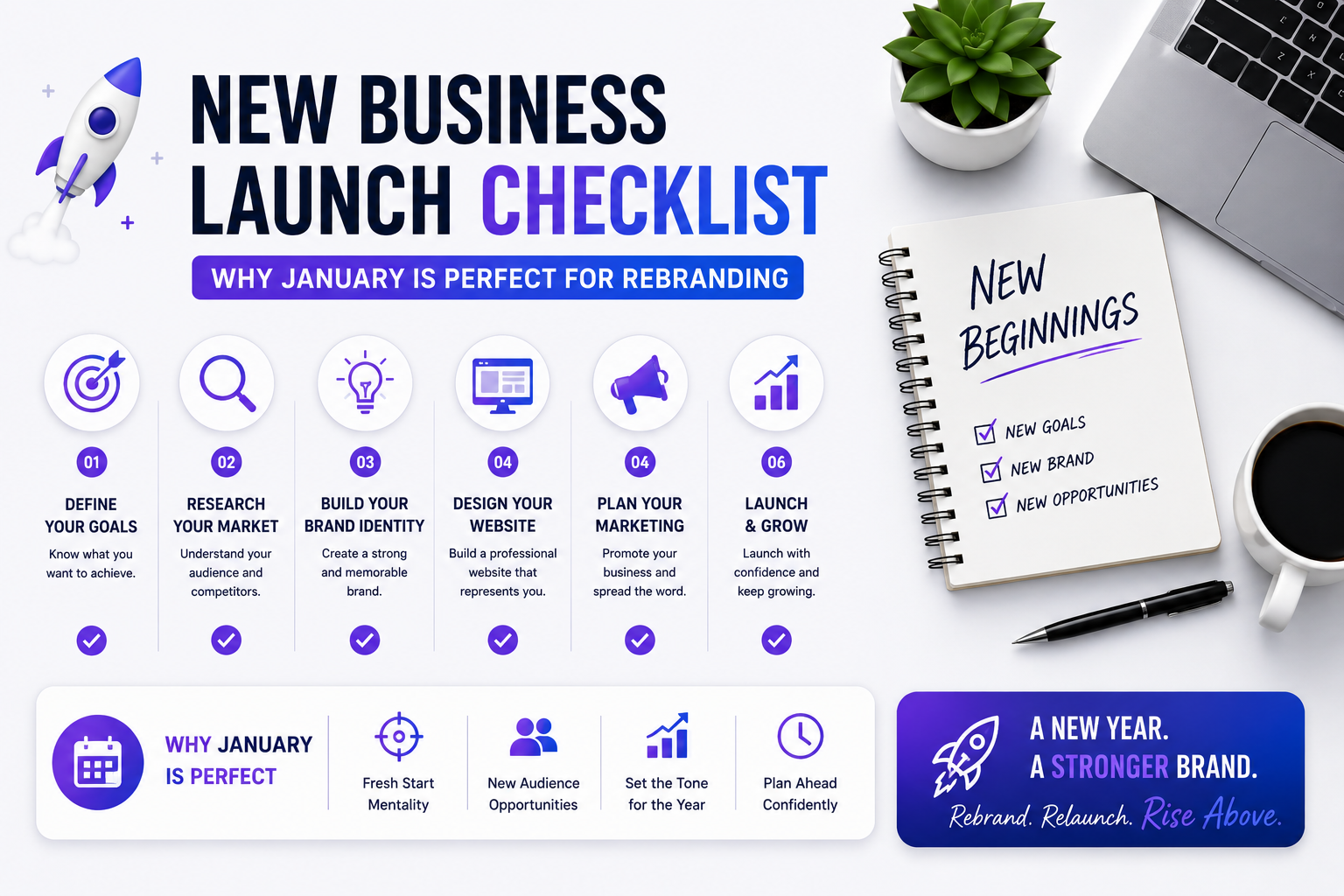
New Business Launch Checklist: Why January Is Perfect For Rebranding
- 39 min read
- Last updated: January 2, 2026

Written by
Ethan Weston
Growth Marketer
January feels different from every other month on the calendar. Everything looks a little cleaner, a little more possible, and that sense of a fresh slate is not just in your head. Customers feel it too, which makes this exact window unusually valuable for business owners thinking about change.
Holiday chaos tends to slow sales for most businesses, and January often becomes the natural pause where owners can step back, rebrand, and come out stronger on the other side. The real question is whether you actually need to make that move right now. Ask yourself honestly whether your business is pulling the same attention it did a year ago.
If the answer is yes, leave things alone. If the answer is no, and your brand feels tired, outdated, or disconnected from where your business has grown, this is exactly where a new year rebranding checklist becomes useful. The hard part is usually knowing what to change, when to change it, and how to avoid a budget that quietly spirals out of control. January gives you the right window to fix all three with a clear plan, and we are walking through exactly what that plan looks like.
Why January Works For Business Launch Branding
A few specific reasons make this month genuinely different from the rest of the year, and understanding them helps explain why so many businesses time their rebrand here on purpose.
FRESH STARTS FEEL NATURAL TO EVERYONE
It is not only you are feeling this shift. Your customers are in new year mode too, which makes them noticeably more open to change and more likely to notice your rebrand without resistance. This single advantage is part of what makes solid business launch branding so much easier to pull off in January than in any random month.
BUSINESS TENDS TO SLOW DOWN
Depending on your industry, January often brings a natural breather after the holiday rush. That quieter stretch gives you real time to focus on getting the details right instead of rushing through decisions under pressure.
YOU GET A BUILT-IN DEADLINE
The new year creates a kind of urgency that “sometime this year” never manages to produce. Telling yourself to finish in January feels real in a way a vague future deadline simply does not.
THE STORY WRITES ITSELF
“New year, new look” is a message people already understand instinctively, which means you spend far less energy explaining yourself. The whole year stretches ahead too, so a January rebrand pays off across eleven more months instead of just a few.
Before You Start: Is Rebranding Really What You Need?
Not every business actually needs a full rebrand, and figuring this out honestly before spending money matters enormously. Sometimes a simple refresh covers it, new colors, updated fonts, a cleaner website, while the core brand stays exactly the same.
Other times a full rebrand is genuinely necessary, a new name, a new look, a complete reset built for where the business is heading next. And sometimes the brand itself is fine, and what you actually need is better marketing to tell people about it more clearly.
A few honest signs suggest you actually need to rebrand rather than simply refresh:
- Your brand looks noticeably dated compared to competitors
- It no longer reflects what your business actually does
- You have expanded into areas your current brand does not cover
- Customers seem confused about who you are
- You feel embarrassed handing out your own business card
- You have merged with or acquired another business
- Your target audience has shifted significantly since launch
If none of these apply, a simple refresh is probably enough. If several do, keep reading, since the real work starts here.
New Year Rebranding Checklist: Steps You Must Know
Here is a clear rebranding timeline broken into steps, walking through exactly what needs to happen and roughly when.
STEP 1: BRAND AUDIT
Before changing anything, you need an honest picture of what currently exists. A brand audit means gathering everything with your name on it in one place, your logo, your website, your social media, your marketing materials, and looking at all of it the way a stranger would.
Ask yourself whether everything looks like it belongs to the same brand, whether anything feels outdated, and whether your messaging stays consistent across every touchpoint. Look at competitors too, since seeing where you fit against them tells you what genuinely needs to change versus what should stay exactly as it is.
STEP 2: MARKET RESEARCH
Once the audit is done, turn your attention outward. Market research means understanding the full context surrounding your business, not just your direct competitors but the unwritten expectations customers in your space already carry.
Talk to actual customers if you can, asking what words come to mind when they think of your brand and what they would change if given the chance. Talk to people who are not customers too, since their outside impression often reveals blind spots you cannot see from the inside. This research keeps you from designing in a vacuum, since even a beautiful brand fails the moment it stops connecting with real people.
STEP 3: DEFINE GOALS
What exactly do you want this rebrand to accomplish? Vague goals like “look more modern” lead to equally vague results, while specific goals like “attract younger customers” or “increase website traffic by thirty percent” give you something concrete to measure against.
Write down three to five solid goals and use them as the filter for every decision from this point forward. When someone suggests a particular color or layout, ask whether it genuinely serves one of those goals. If it does not, keep looking, no matter how appealing the option seems on its own.
STEP 4: GET STAKEHOLDER BUY-IN
If other people need to approve this rebrand, involve them immediately rather than waiting until the design work is finished. Stakeholder buy-in comes far easier when people feel heard from the very beginning of the process.
Share your audit results, your research findings, and your stated goals, then genuinely listen to their input rather than simply informing them of decisions already made. Nothing wastes more time than finishing months of design work, feeling proud of it, and then discovering a partner or investor hates the direction because they were never part of the conversation.
STEP 5: BUDGET PLANNING
Rebranding costs real money and being honest about that early prevents painful surprises later. Budget planning means accounting for everything upfront:
- Design fees covering logo, website, and printed materials
- Copywriting if new messaging needs to be written
- Photography if new images are required
- Printing for business cards, stationery, and packaging
- Updating digital assets across social platforms and email
- Legal costs if you are changing your business name
Get quotes early and build in a buffer for surprises, since costs almost always run higher than the initial estimate suggests.
STEP 6: BUILD YOUR TEAM
You likely cannot pull this off entirely alone, and trying to often costs more in the long run. You need designers who genuinely understand branding rather than people who simply make things look attractive, along with writers, photographers, and developers who can execute the full vision.
Choose people who have handled rebrands before, since this work is a connected system of decisions rather than a single isolated project. Talk to their past clients, ask what problems came up during those projects, and find people you genuinely enjoy working with, since you will spend real time together through stressful moments along the way.
STEP 7: CREATE A TIMELINE
Rebranding takes real time, and rushing the process tends to show in the final result. A realistic rebranding timeline for a small business might run something close to this:
- Week one of January covers the audit, research, goals, and hiring your team
- Weeks two and three focus on strategy, positioning, and messaging
- Early February covers visual exploration and initial concepts
- Late February covers refinement, feedback, and finalization
- March covers brand guidelines and website design and development
- April covers production, printing, and internal staff preparation
- Early May becomes launch week
That stretches to roughly four or five months for a proper rebrand, and sharing this timeline with everyone involved helps keep the whole project on track.
STEP 8: DEVELOP STRATEGY FIRST
Before any actual design begins, get your strategy completely settled, your positioning, your audience, your voice, your values, and your mission. Design without strategy is simply decoration, since it might look attractive without ever genuinely connecting with the right people.
Spend real time here and resist the urge to rush past it, since everything built afterward rests directly on this foundation. A solid foundation lets the rest of the rebrand stand confidently, while a shaky one eventually shows cracks somewhere down the line.
STEP 9: DESIGN AND DEVELOP
This is where the visual identity finally comes to life, the logo, the color palette, the fonts, the website, and every piece of marketing material you have been planning toward. This stage moves through multiple rounds, starting with rough concepts and ending with full application across every touchpoint.
Give feedback that is genuinely specific rather than vague, since “this blue feels too cold for our brand” gives your team something to act on, while “I do not like it” gives them nothing useful at all. Review everything against the goals you set earlier, checking whether each piece actually attracts the audience you want and reflects the values you defined.
STEP 10: PLAN THE ROLLOUT
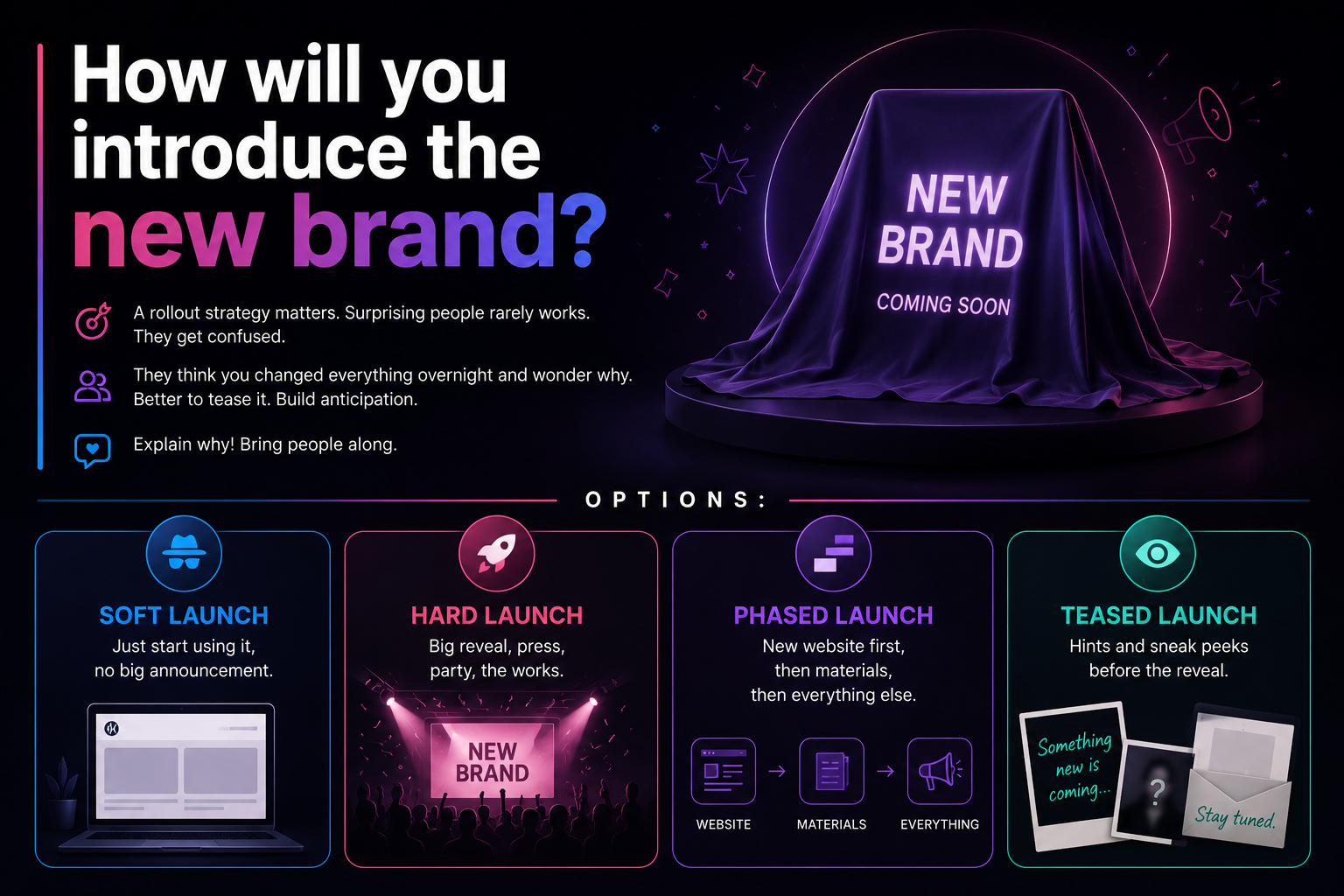
How will you actually introduce the new brand to the world? A clear rollout strategy matters here, since surprising people with an overnight change tend to confuse rather than impress them.
A few common approaches exist depending on your business and budget. A soft launch simply starts using the new brand without a major announcement, while a hard launch goes all in with a big reveal and press coverage. A phased launch rolls out the website first and follows with materials over time, while a teased launch builds anticipation through hints before the full reveal.
STEP 11: CREATE AN ANNOUNCEMENT PLAN
Your announcement plan decides exactly how you will tell the world about the change once it is ready to go live. Your email list deserves to hear it first, since your most loyal customers should never learn about a major change secondhand.
Social media comes next, ideally with a short explanation of why the change happened rather than just a new logo appearing without context. Your website should update alongside the announcement rather than lagging behind it, and a quick personal note to your most important customers goes a remarkably long way.
STEP 12: BUILD IN ROOM FOR FEEDBACK LOOPS
Even with a strong team and a clear timeline, rebrands rarely move in a perfectly straight line. Building in scheduled feedback checkpoints, rather than waiting until a piece feels finished to share it, catches misalignment early when it is still cheap to correct.
A short check-in after initial concepts, another after the first round of refinement, and a final review before anything goes to print keeps surprises to a minimum. This structure also protects your team's time, since fewer last minute overhauls mean fewer late nights scrambling to fix something that should have been caught two weeks earlier.
When To Rebrand Business: Key Timing Questions
Still genuinely unsure about when to rebrand business rather than simply refresh it? A few honest questions usually settle the matter quickly.
- Is your brand keeping pace with competitors in your space?
- Do customers still understand exactly what you do?
- Do you feel proud handing someone your business card?
- Has your business changed significantly since you started?
- Does your current audience look different than it once did?
Answering yes to several of these is a strong signal that the timing has arrived.
Updating Everything Before Launch
Before launch day arrives, every single asset needs to be ready, not most of them, all of them. Your website gets the new look first, followed by every social media profile, not just the main ones you remember off the top of your head.
Email signatures, business cards, stationery, packaging, signage, and even vehicle wraps if your business uses them all need updating before the public sees anything new. Build a master list of every place your brand appears, then work through it methodically and check each item off as it gets updated, since launching with one forgotten profile still showing the old logo looks sloppy and confuses customers.
This list tends to grow longer than expected once you actually sit down and write it out. Think through third party listings too, directories, review platforms, partner websites, and any marketplace profiles that still carry your old branding. Reaching out to these external sites ahead of launch, rather than after, prevents your new brand from feeling incomplete the moment a customer searches for you somewhere outside your own channels.
LAUNCH AND MONITOR
Launch day finally arrives, and once that publish button is hit, the real work shifts toward watching closely rather than walking away. Monitor comments and reactions across every platform, respond to questions quickly, and address concerns honestly without becoming defensive.
Track whatever metrics you can, website traffic, social engagement, and sales figures, looking for patterns in how people respond. Be patient with customers who need time adjusting to the new look, since some initial pushback is simply discomfort with change rather than genuine dislike, and most people come around once they realize the business they trusted is still exactly the same underneath the new appearance.
Set aside a small window each day during the first two weeks specifically for monitoring, rather than checking sporadically whenever you remember. A consistent habit catches small issues, a broken link, a mismatched color on one platform, a confused comment thread, before they grow into something that needs more cleanup than it would have a day earlier.
POST-LAUNCH REVIEW
A few weeks after launch, pause and look back honestly at the entire process. What went well, what would you do differently next time, and what feedback have customers actually shared since the new brand went live?
Document all of this while it remains fresh, since every rebrand teaches lessons worth remembering for next time. Most importantly, revisit the specific goals you set back in step three and check whether you actually accomplished them, adjusting messaging or strategy wherever the gap suggests something still needs work.
It also helps to schedule a second review further out, somewhere around the three month mark, since some shifts in customer behavior only become visible once the initial novelty has worn off. Comparing this later data against your first post-launch snapshot shows whether early momentum held steady or whether certain messages need reinforcing.
COMMON BUSINESS LAUNCH BRANDING MISTAKES
A few mistakes show up again and again across rebrands and avoiding them saves real time and money.
- Skipping the audit, which leaves you guessing at what genuinely needs to change
- Ignoring stakeholder buy-in, since people tend to resist changes they had no part in shaping
- Rushing the timeline, since cut corners almost always show in the final result
- Ignoring loyal existing customers instead of bringing them along through the change
- Rolling out inconsistently, with the new logo appearing in some places and the old one lingering in others
- Skipping the announcement entirely, leaving customers confused about why anything changed at all
NEW YEAR REBRANDING CHECKLIST TIPS FOR A SMOOTH LAUNCH
If you are launching something new alongside your rebrand, a few extra habits make the whole rollout land more smoothly.
- Coordinate your timing so everything launches together for maximum impact rather than scattering announcements across separate moments.
- Tell one unified story that ties the rebrand and any new offering together rather than presenting them as two unrelated events.
- Focus on real benefits for customers, explaining what is actually easier, clearer, or better now rather than simply describing what looks different.
- Get your own team genuinely excited before the public launch, since they become your first and most credible ambassadors.
- Build some anticipation beforehand through small hints or countdowns, since curiosity tends to make the eventual reveal land harder.
- Follow up with customers about a week after launch to check in, showing that you care about their experience and not just the new look itself.
FREQUENTLY ASKED QUESTIONS
HOW DO I KNOW IF I NEED A FULL REBRAND OR JUST A REFRESH?
A refresh works if your core brand still fits but feels slightly stale, while a full rebrand becomes necessary once your business has genuinely outgrown its current identity.
WHY IS JANUARY SPECIFICALLY A GOOD TIME TO REBRAND?
Customers are naturally more open to change during this period, business tends to slow down enough to focus properly, and the new year provides a built-in deadline and story.
HOW LONG DOES A PROPER REBRAND REALISTICALLY TAKE?
Most small businesses need roughly four to five months from the initial audit through full launch, though rushing this timeline tends to show in the final quality.
WHAT IS THE BIGGEST MISTAKE BUSINESSES MAKE WHEN REBRANDING?
Skipping the strategy work and jumping straight into design tends to cause the most long-term damage, since the result often looks nice without genuinely connecting with the right audience.
SHOULD I TELL CUSTOMERS WHY I AM REBRANDING?
Yes, since a brief explanation prevents confusion and helps loyal customers feel included in the change rather than blindsided by it.
LET US GUIDE YOU THROUGH YOUR REBRAND
January brings fresh energy, slower business, and a natural story that makes rebranding genuinely easier to pull off well. Start with a brand audit to understand what you currently have, follow it with real market research, and secure stakeholder buy-in before spending a single dollar.
Plan your budget realistically, build a timeline that allows the process room to breathe, and develop your strategy fully before any design work begins. A clear rollout strategy and announcement plan bring your customers along for the change instead of confusing them along the way. This new year rebranding checklist keeps the entire process on track, step by step, decision by decision, until your business finally looks like the place you always knew it could become.
At The Designers Agency, we have guided dozens of businesses through rebrands exactly like this one. We build a rebranding timeline that genuinely works for your business, handle budget planning so nothing catches you off guard, and help with rollout strategy and announcement plans that bring your customers along rather than leaving them behind. Let us get to work today.
Table Of Content
Why January Works For Business Launch Branding Before You Start: Is Rebranding Really What You Need? New Year Rebranding Checklist: Steps You Must Know When To Rebrand Business: Key Timing Questions Updating Everything Before Launch COMMON BUSINESS LAUNCH BRANDING MISTAKES NEW YEAR REBRANDING CHECKLIST TIPS FOR A SMOOTH LAUNCH FREQUENTLY ASKED QUESTIONS LET US GUIDE YOU THROUGH YOUR REBRAND
Unlocking Digital Prowess through Innovative Solutions and Unparalleled Customer Service.