
The Rise Of Micro-Agencies: Why Small Design Teams Deliver Better Results
- 11 min read
- Last updated: June 22, 2026

Written by
Ethan Weston
Growth Marketer
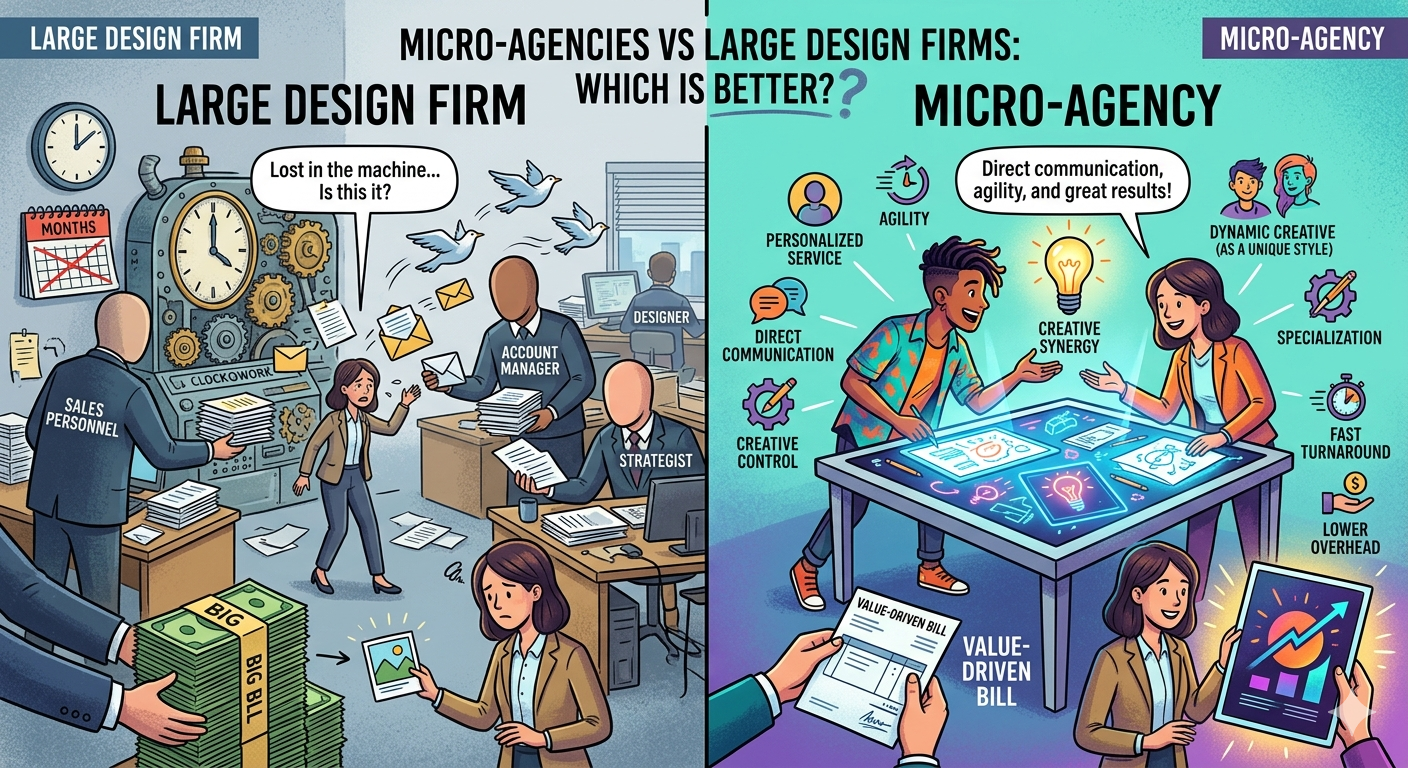
Remember the old way of hiring an agency? You would look for a big name firm with a fancy website and an impressive client list, only to find yourself meeting with sales personnel first, then an account manager, then a strategist, and maybe, if you were lucky, a designer somewhere down the line.
Months would pass, emails would fly back and forth, meetings would multiply like rabbits, and somewhere along the way, whatever made your business special and unique got completely lost in the bureaucratic machine.
Then the bill would come, and it would be exclusively massive, leaving you staring at the work and thinking to yourself, “This is it? This is what I paid all that money for?” That all-too-common experience is precisely with micro-agencies vs large design firms. That’s why so many business owners have developed deep trust issues with traditional agencies, because they have been through the wringer, paid too much, waited too long, and got far too little in return.
Something Has Changed
But something has fundamentally shifted in the last few years, because smaller teams are popping up everywhere, and they are completely disrupting the old agency model in ways that benefit clients enormously. Micro-agencies, boutique shops, and tiny crews of seriously talented people are doing work that absolutely blows the big guys away, and they are doing it faster, cheaper, and with more creativity than anyone expected.
They actually seem to care about their clients, which is why today we are taking a deep look at micro-agencies vs large design firms, exploring why smaller often wins, what makes them fundamentally different, and why smart businesses everywhere are making the switch.
What Exactly Is A Micro-Agency?
Let's get crystal clear on what this term means, because it gets thrown around a lot in marketing circles without a consistent definition that everyone agrees on. A micro-agency is simply a small team of specialists, usually somewhere between two and ten people, though sometimes it is just one incredibly talented person with a reliable network of trusted collaborators they bring in when specific projects require additional firepower.
They focus on personalized service and doing a few things exceptionally well instead of trying to do everything just okay, whether that is web design, branding, content creation, or whatever their specific specialty happens to be. They don't pretend to be good at everything, and they are refreshingly honest about what falls outside their wheelhouse.
WHAT THEY DON'T HAVE
Here is what they don't have: no layers of management standing between you and the actual work, no account teams that filter your feedback through multiple channels, and no salespeople who disappear the second the contract is signed, never to be heard from again.
Just the actual people doing the actual work, talking directly to the people who need it done, with no bureaucracy, no runaround, and no unnecessary complexity. That is the whole model in a nutshell, small on purpose, focused by design, and direct in every single interaction.
How Big Agencies Work (And Where They Fail)
THE PURPOSE OF BIG AGENCIES
Let me be completely fair here, because big agencies are not evil and they absolutely serve an important purpose in the right circumstances. When you need a global campaign in twenty countries with TV spots, billboards, and a Super Bowl commercial, you definitely need a big agency with the infrastructure and resources to pull that off.
But most businesses do not need that scale, most businesses need a website, or a logo, or some marketing materials, agility, maybe a video, and for those kinds of projects, big agencies are often the wrong tool for the job entirely.
THE LAYER PROBLEM
Here is what actually happens inside a big agency: you meet with a “business development” person who is nice enough but who will not be on your project after the contract is signed. Then you get handed to an “account manager” who is also nice but does not actually do the work either. Then maybe a “strategist” does some research, then a “creative director” thinks up ideas, then a “designer” executes them, and finally a “project manager” keeps everything moving.
That is six different people before anyone actually touches your project, and every single handoff loses something valuable along the way.
THE COST OF COMPLEXITY
Every layer adds cost, every meeting eats time, and by the time the work actually reaches the real designer, it has been filtered through five other people who each had their own interpretations and assumptions. The original brief gets diluted, the urgency gets lost, the personality gets smoothed over, and you are paying for all those layers whether you realize it or not.
It is a system designed for large-scale complexity, not for the kind of focused, personal work that most small and medium businesses actually need.
The Micro-Agency Difference
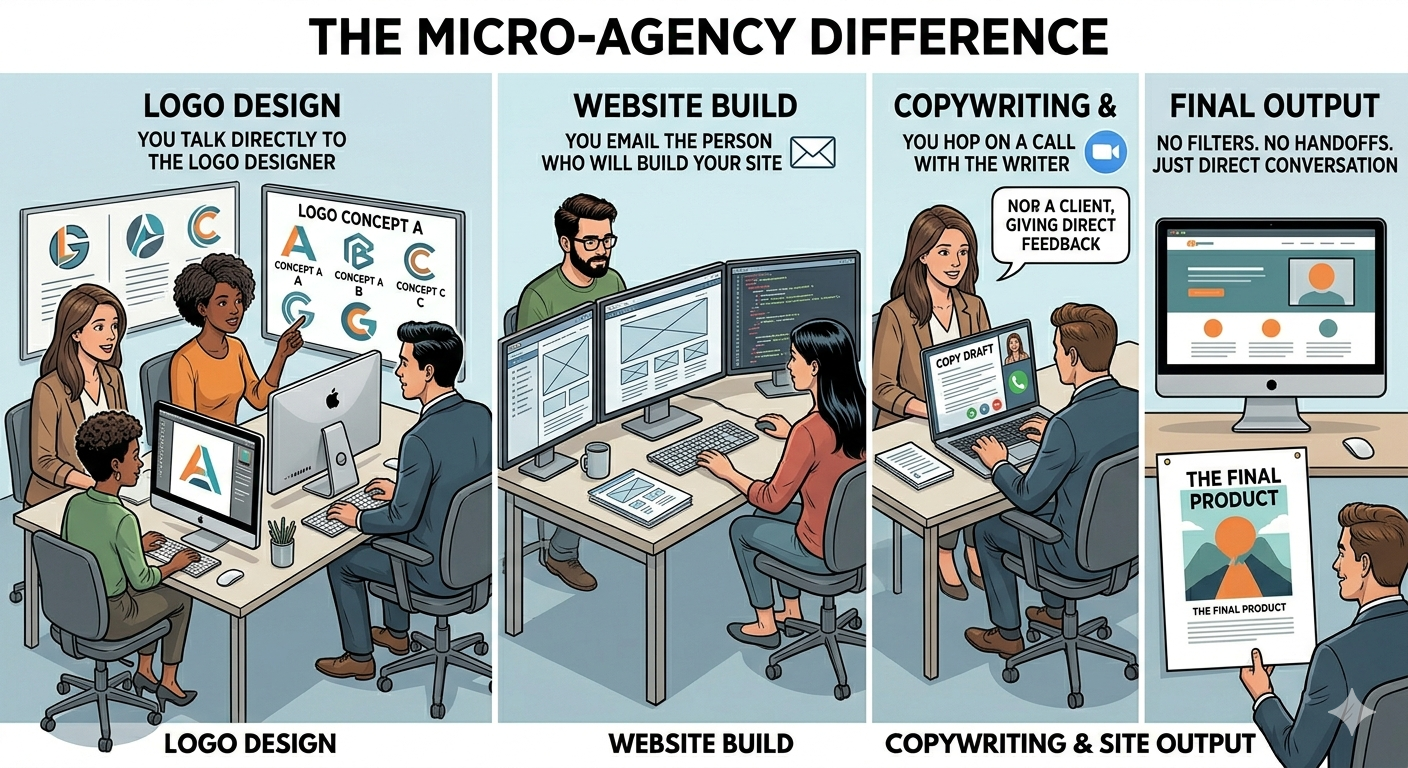
Now look at how a micro-agency actually works compared to the old model, and the contrast is genuinely striking. You talk directly to the person who will design your logo, you email the person who will build your site, and you hop on a call with the person writing your copy, no filters, no handoffs, no games, just direct human-to-human conversation that gets things done efficiently.
FASTER DECISIONS
Questions get answered in minutes, not days, because you do not wait for someone to check with someone else who needs to check with someone else before you get a response. Just ask and get answers immediately.
BETTER COMMUNICATION
Nothing gets lost in translation because there is no translation layer to begin with, you talk to the doer, they hear exactly what you mean, not what an account manager thought you meant after a game of telephone.
STRONGER IDEAS
The person doing the actual work hears your vision directly from you, so they understand the nuances, the feelings, and the context that always gets lost in multiple handoffs between different departments.
LOWER COSTS
You are not paying for layers of management that do not actually do anything productive, because there are no account executives, no project managers, and no creative directors who just supervise rather than create. Your money goes directly to the people making things.
MORE FLEXIBILITY
Need to pivot because something changed in the market? Small teams change direction fast, with no meetings about meetings and no approval chains that take weeks to navigate. Just adapt and go.
It is simply simpler, and in business, simpler almost always wins over complicated, always has, and always will.
Micro-Agencies Vs Large Design Firms – Understand The Whole Science
Many businesses are not entirely sure why they should choose micro-agencies, and they often wonder if there are any real small branding agency benefits that justify going small instead of big. Without further ado, here is a comprehensive agency size comparison just for you, so you can make an informed decision based on facts rather than assumptions.
Personalized Service That Actually Feels Personal
THE NUMBER PROBLEM
Here is what clients consistently say about big agencies: “I felt like a number, just another account in a massive portfolio that didn't really matter to anyone.” And here is what clients say about micro-agencies: “They actually knew my business, my customers, and my goals without me having to explain everything from scratch every single time.” Personalized service is not just a buzzword with small teams, it is the only way they can compete, and they take it seriously.
WHY SMALL TEAMS WIN AT PERSONALIZATION
When you are a small agency, every single client matters deeply, and you cannot afford to treat anyone like a number because your reputation depends entirely on the quality of your relationships. You win by caring more, by knowing more, and by delivering more than anyone expects, which means learning your business inside out, understanding your customers thoroughly, and remembering your goals without constantly looking at notes.
It means being available, responding to emails promptly, picking up the phone when you call, and treating you like a partner rather than a paycheck.
THE CARING FACTOR
The big agency might have fancier offices and more awards on the wall, but the micro-agency has something far more valuable: they give a damn about your success, and that genuine investment in your outcomes makes all the difference in the quality of the work they produce.
Agility: Moving Fast When You Need To
THE SPEED OF BUSINESS
Business moves incredibly fast now, with opportunities popping up overnight, competitors making sudden moves, and trends shifting before you finish your morning coffee. The question is whether your agency can actually keep up with that pace, or whether they will slow you down when you need to move fastest.
BIG AGENCY BUREAUCRACY
Big agencies have processes, lots and lots of processes, and change requests have to go through proper channels, approvals take time because layers of management exist, and rush jobs cost extra because they mess up the carefully calibrated system. Speed is simply not their friend, and that becomes a significant liability when the market demands rapid response.
SMALL TEAM AGILITY AND CREATIVE CONTROL
Agility is where small teams absolutely shine, because they can turn on a dime without asking permission from five different departments. Need a new landing page by Friday? Done. Competitor launched something and you need to respond today? On it. Saw a trend on social media and want to jump on it right now? Let's go, we are already moving.
THE DECISION-MAKING ADVANTAGE
Small teams do not have meetings about whether to have meetings, and they do not need to discuss if they should discuss things before taking action. They just do the actual work and figure things out as they go, which means when speed matters most, size becomes a liability and small wins every single time.
Lower Overhead Costs (Passed To You)
THE BIG AGENCY EXPENSE PROBLEM
Big agencies have big expenses across the board, including fancy offices in fancy buildings, receptionists, IT departments, HR people, marketing teams to market themselves, and executives with executive salaries. Someone pays for all of that, and that someone is you, whether you realize it or not.
WHERE YOUR MONEY GOES
Overhead costs at big agencies can run fifty percent or more of what you are paying, which means half your budget goes to things that have absolutely nothing to do with your project or your results. You are subsidizing their real estate, their administrative staff, and their internal operations rather than paying for creative work that actually benefits your business.
THE MICRO-AGENCY ADVANTAGE
Micro-agencies work differently entirely, with teams working from home or small studios, no layers of management to support, no departments for everything, and no bloated infrastructure to maintain. They just have talented people doing great work, which means more of your budget goes to actual design, actual strategy, and actual results rather than fancy lobbies and executive salaries.
BETTER VALUE FOR MONEY
You are not paying for a beautiful reception area or a corporate jet, you are paying for people who make your business better, and that is a much better use of your marketing dollars.
CREATIVE CONTROL WITHOUT THE EGO
THE EGO PROBLEM
Big agencies have reputations to protect, award shows to win, and massive egos to manage constantly throughout the creative process. Sometimes that is fine, but sometimes it actively gets in the way of what you actually need for your business.
VISION VS. PORTFOLIO
You might have a clear vision for your brand based on years of knowing your customers inside out, but the agency wants to do something “award-worthy” that looks impressive in their portfolio even if it is completely wrong for your actual business. Creative control can slip away fast when egos enter the room, and you end up with something that looks good but does not actually work.
THE MICRO-AGENCY APPROACH
Micro-agencies are completely different, because they care about their work and they are proud of what they make, but they care even more about happy clients who succeed in their own markets. They will push back when they think you are making a mistake, because that is literally their job as experts, but they will also listen when you explain that you know your business better than they do.
THE WORK SERVES YOU
The work serves you, not their award shelf, and that is the whole difference between the two approaches, one is about making the agency look good, and the other is about making you successful.
When Big Agencies Actually Make Sense
BEING FAIR ABOUT SCALE
Let's be completely fair here, because big agencies absolutely have their place in the world and they serve certain clients extremely well for specific types of projects. They exist for a reason, and dismissing them entirely would be just as foolish as assuming they are always the right choice.
MASSIVE CAMPAIGNS ACROSS MULTIPLE COUNTRIES
If you need to launch in twenty markets simultaneously with TV spots, billboards, and coordinated press across multiple languages and cultures, you need the big guns with the infrastructure to handle that complexity. They have the resources, the global network, and the experience to pull off campaigns of that magnitude.
FIFTY PEOPLE WORKING ON YOUR ACCOUNT
Some projects genuinely require that many hands, including complex technical integrations, massive content production, and around-the-clock work across time zones. Big agencies can staff that level of effort in ways that small teams simply cannot match with zero percent chance of direct communication.
SEVEN-FIGURE BUDGETS WITH EVERY SERVICE UNDER ONE ROOF
When money is no object and you want strategy, creative, production, media buying, and PR all from one source with seamless integration, big agencies deliver that integrated package. But for most businesses reading this, small to medium, growing steadily, focused on their niche, that is complete overkill.
THE SWEET SPOT
You do not need an army; you need a few brilliant people who actually understand your business and genuinely care about your success. That is the micro-agency sweet spot right there: big enough to deliver, small enough to care.
What To Look For In A Boutique Design Agency
MAKING THE RIGHT CHOICE
Thinking about going small for your next project? Here is what actually matters when evaluating who to trust, because not all micro-agencies are created equal and you need to separate the exceptional ones from the merely adequate.
PORTFOLIO, NOT PROMISES
Ignore the smooth talking and look at work they have actually delivered for real clients, because results speak louder than promises every single time. Does their style match what you want, and does their quality level meet your standards?
INDUSTRY EXPERIENCE
Have they worked with businesses like yours before? Not strictly mandatory, but definitely helpful, because industry knowledge means less time explaining basic things and more time creating genuinely valuable work.
PROCESS QUESTIONS
How exactly do they work? How will you communicate throughout the project? What is their realistic timeline for delivery? Clear, honest answers to these questions separate true professionals from amateurs who are just figuring things out as they go.
PERSONALITY FIT
You will work directly with these people for weeks or months, so make sure you actually enjoy talking to them and feel comfortable sharing your honest thoughts. Chemistry matters more than you might think, because creative work requires trust and openness.
REFERENCES
Ask for past client conversations, and find out whether they were truly happy, whether they would hire them again, and whether any problems came up and how they were handled. Honest references reveal everything you need to know with proper specialization.
Personalized Service – What A Small Team Can Do
THE BOTTOM LINE
Micro-agencies vs large design firms is not really a fair fight for most businesses, because there is not some eye-opening agency size comparison that makes the big firms look better for the typical client. Large firms offer scale, and if you genuinely need scale, great, go there without hesitation. But for everything else, strategy, creativity, speed, value, and genuine partnership, smaller is almost always better.
THE FULL PACKAGE
The small branding agency benefits include personalized service where people actually know you and care about your success, client relationships that last years rather than weeks, agility that lets you move fast when opportunities appear, lower overhead costs that mean more budget goes to your actual work, direct communication with the people doing the designing, creative control without ego battles, and specialization in exactly what you need rather than a one-size-fits-all approach.
Ready To Work With A Team That Actually Cares?
When you weigh micro-agencies vs large design firms, the choice becomes remarkably clear for most growing businesses. Large firms offer scale and infrastructure, but they come with layers of bureaucracy, inflated overhead costs, and diluted communication that leaves you feeling like just another account.
Micro-agencies offer something far more valuable: direct access to talented specialists who genuinely care about your success, move at the speed of business, and deliver work that actually reflects your brand. If you are ready for a partnership that puts your business first rather than an agency's bottom line, a micro-agency is the smartest choice you can make.
Table Of Content
Something Has Changed What Exactly Is A Micro-Agency? How Big Agencies Work (And Where They Fail) The Micro-Agency Difference Micro-Agencies Vs Large Design Firms – Understand The Whole Science Personalized Service That Actually Feels Personal Agility: Moving Fast When You Need To Lower Overhead Costs (Passed To You) CREATIVE CONTROL WITHOUT THE EGO When Big Agencies Actually Make Sense What To Look For In A Boutique Design Agency Personalized Service – What A Small Team Can Do Ready To Work With A Team That Actually Cares?
Unlocking Digital Prowess through Innovative Solutions and Unparalleled Customer Service.