
The Ultimate Guide To Building A Brand Identity From Scratch In 2026
- 57 min read
- Last updated: July 12, 2026

Written by
Ethan Weston
Growth Marketer
Starting from zero is terrifying. There are no customers yet, no reputation behind your name, and no recognition to lean on, just you, an idea, and a stubborn amount of hope. Somewhere in the middle of all that, you are expected to figure out this entire “brand” thing.
What does your brand look like? What does it sound like, and what does it actually stand for? Will anyone even care that it exists? Most people freeze right here, and the ones who push through often grab whatever they can scrape together, a logo from a cousin, a template website, colors picked simply because they liked them.
Then they wonder why nobody takes them seriously. Here is the part nobody tells you though: building a brand from nothing is challenging, but it is not actually difficult once you understand it is just a procedure with clear steps. Knowing how to build brand identity the right way removes nearly all of the fear, because you are no longer guessing your way through it. We are walking through the real steps that turn a raw idea into something people genuinely remember.
Why Brand Identity Development Matters When You Are Small
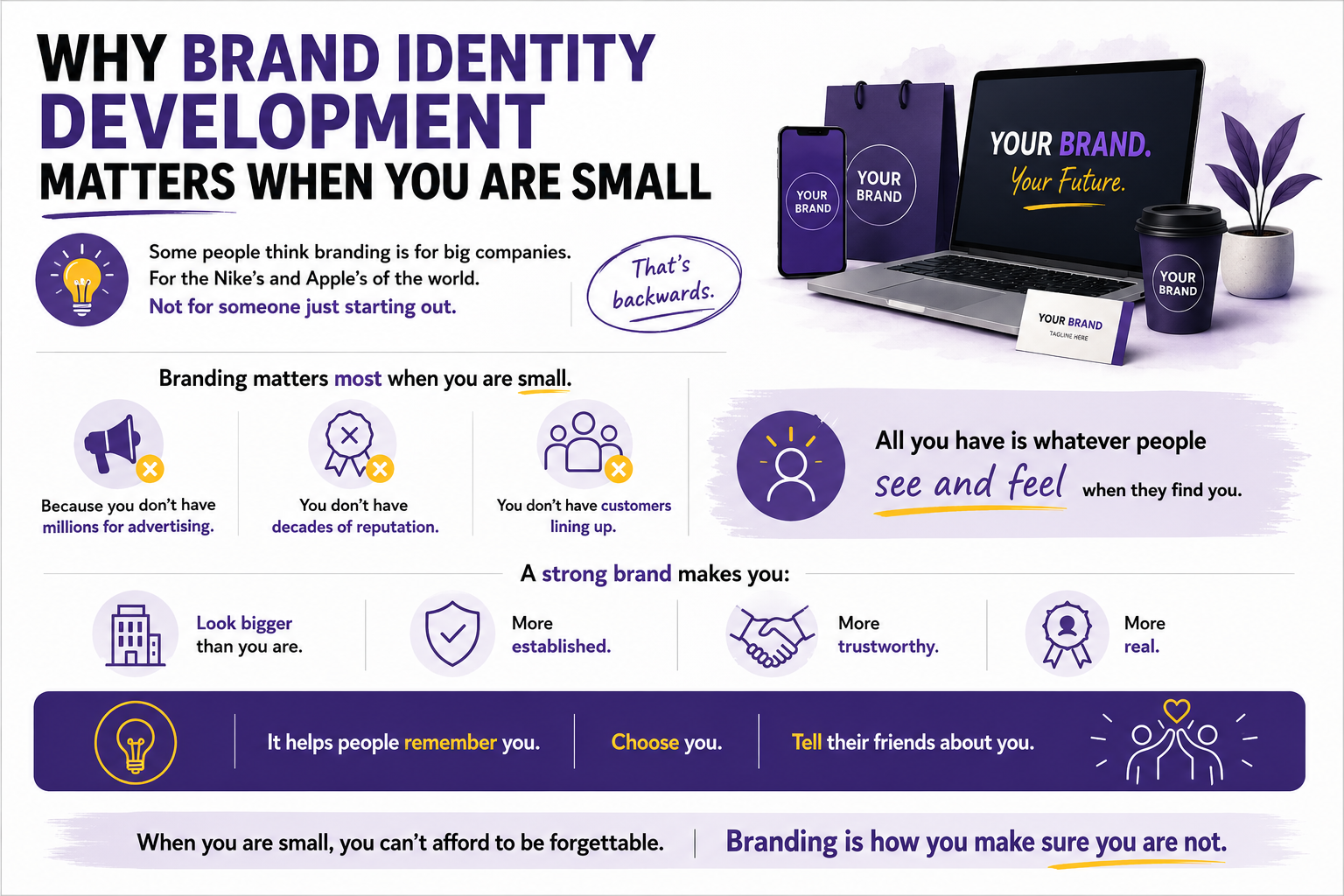
Some people assume branding only matters for massive companies, the Nikes and Apples of the world, and that smaller businesses can skip straight to selling. That assumption has it backwards entirely.
Brand identity development matters most precisely when you are small, since you have no advertising budget to fall back on, no decades of reputation, and no customers already lined up waiting. All you really have is whatever people see and feel the moment they encounter you for the first time.
A strong brand makes a small business look more established and more trustworthy than it technically is yet. It helps people remember you, choose you over a competitor, and tell their friends about you without being asked. When you are small, being forgettable is the one thing you genuinely cannot afford.
STEP 1: BRAND POSITIONING
Before any colors, fonts, or logos get chosen, you need to know exactly where you stand. Brand positioning answers one specific question: what space do you want to own inside people's minds?
Think about brands you already know well. Volvo owns safety, Nike owns performance, and Tiffany owns luxury, so hearing those single words brings the brand instantly to mind. What single word do you want people to associate with your name the moment they hear it?
This is not about sounding clever. It is about being unmistakably clear, since trying to own everything usually means you end up owning nothing at all. Strong brand positioning tends to share a few qualities worth checking your own against:
- True to who your business actually is, not who you wish it were
- Genuinely different from your closest competitors
- Something your customers actually care about
- Simple enough to explain in a single sentence
Write your positioning down once you land on it, since it becomes the filter every future decision gets measured against.
STEP 2: KNOW YOUR TARGET AUDIENCE
This is where most new brands stumble badly. They try to speak to everyone at once, saying something like “our product is for anybody who wants quality,” which sounds reasonable but means nothing useful to anyone reading it.
When you talk to everyone, you genuinely connect with no one. Real target audience work means getting specific rather than staying broad. Instead of “small business owners,” try “bakeries in Chicago that want to sell more cakes online.” Instead of “busy moms,” try “working moms in Texas with kids under five who need fast dinner solutions.”
The more specific you get, the more people feel personally seen rather than generally addressed. A few questions help sharpen this picture considerably:
- Who genuinely needs what you offer?
- What do they care about most?
- What keeps them up at night?
- Where do they spend their time online?
Build a picture of one real person rather than a vague demographic and speak to that person directly rather than to a faceless crowd.
STEP 3: COMPETITOR ANALYSIS
You are not the first business in your space, and you will not be the last either. Competitor analysis is not about copying what others do. It is about genuinely understanding the landscape you are entering.
Who else already serves your customers, and what do they do well or poorly? Look closely at their websites, their social media presence, and their reviews to see what customers consistently love or complain about. This single exercise reveals two things at once.
First, it reveals what your industry already expects, the look and feel customers have come to assume as normal. Second, it reveals exactly where you can be different in ways that actually matter, whether that means a warmer tone where competitors feel corporate, or a distinct color where everyone else defaults to the same blue.
STEP 4: DEFINE YOUR BRAND VALUES
Brand values can sound like empty corporate language, yet they matter more than most business owners initially assume. Values describe the principles guiding how you operate, not simply what you happen to sell.
Are you obsessed with quality above all else? That is a value. Do you put customers first no matter the cost to convenience? That is a value too. These principles matter because they help you make decisions quickly whenever two options pull in different directions, and they help the right customers recognize themselves in your brand.
Pick three to five values that genuinely describe how your business operates day to day, rather than generic words like integrity or excellence that could apply to literally anyone.
STEP 5: CREATE YOUR MISSION STATEMENT
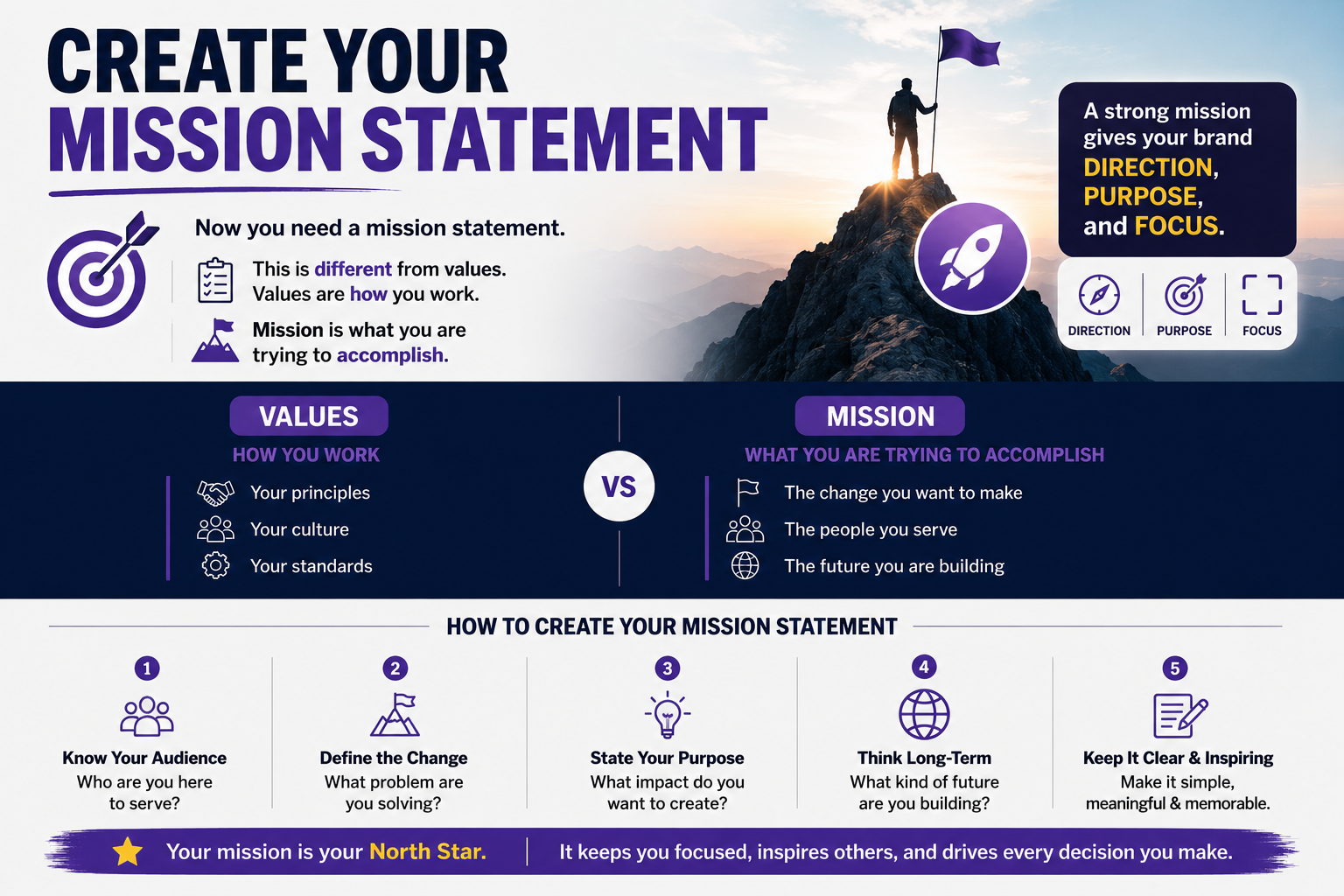
A mission statement differs from values in one key way: values describe how you work, while mission describes what you are actually trying to accomplish in the world.
A strong mission statement answers three simple questions: what you do, who you do it for, and what change you create as a result. Your mission does not need to sound as ambitious as Tesla's vision of accelerating sustainable transport worldwide. It simply needs to be true and immediately clear.
“Help local bakeries sell more cakes online” works perfectly well as a mission statement, since it is specific, real, and tells anyone reading exactly what your business stands for.
STEP 6: DEVELOP YOUR VERBAL IDENTITY
Verbal identity is how your brand sounds across every piece of writing it produces. Are you formal or casual? Do you reach for simple words or technical ones, and do you say hello or hey when greeting a customer?
This matters more than most business owners expect, since every word you write, whether on your website, in emails, or across social media, quietly teaches people who you are. Write down three words that describe your brand voice, something like friendly, expert, or warm, whatever genuinely fits your business.
From there, build a few simple guidelines around tone, such as whether you use emojis, contractions, or jokes, since a consistent voice helps people recognize you even before they see your logo.
STEP 7: CREATE YOUR VISUAL IDENTITY
Now comes the part most people picture when they think about branding. Visual identity includes your logo, but it stretches far beyond just that single asset.
WHAT VISUAL IDENTITY ACTUALLY INCLUDES
You need a main logo along with variations built for different uses, a full version, a simplified one, and possibly a symbol that stands alone. Your color palette needs primary colors for major impact alongside secondary colors that support them, while your typography choices for headlines and body text carry their own quiet personality.
Imagery style matters more than most people realize too, covering the kind of photos you use, any illustrations or patterns, and even the layout principles guiding how elements sit on a page. Every piece needs to work together, with your colors feeling like an extension of your voice and your fonts matching your overall personality.
Everything also needs flexibility built in from the start. Your logo will appear tiny on a phone screen and enormous on a billboard, so it needs to hold up clearly in both situations. Good Visual identity feels intentional throughout, where nothing was chosen at random, even if the average viewer cannot articulate exactly why it feels right.
STEP 8: BUILD YOUR BRAND GUIDELINES
This is where most brands quietly fall apart. All that strategy and design work gets completed, and then nobody writes it down anywhere. Six months later, someone new is designing a flyer and guessing which exact shade of blue to use.
A complete branding guide functions as your rulebook, documenting everything in one place so guessing never becomes necessary again:
- Logo usage, including what not to do and minimum size requirements
- Exact color codes for both screen and print
- Font choices for headlines versus body text
- Voice guidelines, including words to use and words to avoid
- Imagery direction, including what styles to avoid entirely
- Real application examples across your website, business cards, and social media
Strong guidelines are clear enough that anyone could pick them up and create something that genuinely feels like your brand, without needing to ask you a single question.
STEP 9: PROMOTE YOUR BRAND EVERYWHERE
Once all that strategy and design work is finished, you actually have to use it consistently. Start with your website, since this is where most people meet your brand for the first time, and every page should follow your guidelines without exception.
From there, move to social media, where profile photos, cover images, and post templates should all feel unmistakably consistent. Business cards, email signatures, proposals, and invoices all matter too, since every single touchpoint a customer encounters is a quiet chance to reinforce who you are.
The goal is simple in the end. Someone should be able to see any single piece of your brand, anywhere, and know immediately it belongs to you. That recognition is what eventually builds trust, and consistency is essentially free advertising once it is in place.
STEP 10: PROTECT AND EVOLVE
Brand identity development does not stop once your guidelines are written, since you now need to protect what you built while still allowing it room to evolve naturally over time. Pay attention to how people actually react once your brand is out in the world.
If everyone consistently mispronounces your name, that name might be more complicated than it needs to be. If customers keep asking the same confused question, your messaging likely needs sharpening rather than your entire identity needing a rebuild.
Do not chase every passing trend or overreact to a single piece of negative feedback. Stay loyal to your core identity while still allowing thoughtful change over time, since genuine evolution refines the details while preserving the underlying spirit of the brand.
Common Brand Strategy Framework Mistakes
Every business owner makes mistakes while building a brand, and that is normal. Some mistakes simply cost more than others, so learning from a brand strategy framework that has already been tested elsewhere can save you real time and money.
SKIPPING THE STRATEGY ENTIRELY
This remains the most common mistake by a wide margin. Someone jumps straight to logo design, picks colors they personally like, and ends up with something that looks pleasant but connects with nobody, since it was never built on real understanding of the customer.
COPYING COMPETITORS DIRECTLY
This feels safe in the moment but proves genuinely dangerous over time, since it produces a brand that blends in perfectly with everyone else. Customers struggle to tell you apart from competitors, which removes any real reason to choose you specifically.
MAINTAINING AN INCONSISTENT VOICE
A website that sounds formal, paired with social media that jokes around constantly, leaves customers confused about who your brand actually is. A brand should feel like the same person showing up everywhere, not several different personalities competing for attention.
TRYING TO HOLD TOO MANY IDEAS AT ONCE
Attempting to be luxury and affordable, serious and playful, traditional and cutting edge all at once usually results in a brand that means nothing specific to anyone. Strong brands commit to standing for something, even if that means losing customers who were never the right fit.
OPERATING WITH NO WRITTEN GUIDELINES
Without documentation, a brand slowly drifts as new employees and freelancers each guess slightly differently at colors, fonts, and tone. What once felt carefully built eventually erodes into visual confusion across every touchpoint.
IGNORING CUSTOMER FEEDBACK
Customers are constantly telling you what confuses them and what they genuinely love, and ignoring that feedback is a quiet but serious mistake. Brands that listen tend to keep improving, while stubborn ones slowly fade from relevance.
How To Build Brand Identity: The Realistic Timeline
How long does building a brand actually take? That depends heavily on how thorough you want to be and how quickly decisions get made along the way. Here is a realistic timeline to set proper expectations from the start.
WEEKS ONE THROUGH TWO
The early focus sits entirely on building a strategic foundation. This is where brand positioning gets defined, where you clarify who you are as a business and who your customers actually are. Competitor analysis also happens here, alongside defining your core brand values and mission statement, with no actual design work happening yet.
WEEKS THREE THROUGH FOUR
Attention shifts toward verbal identity creation during this stretch. You finalize your tone, whether casual, formal, or somewhere in between, and develop messaging guidelines along with key phrases you will use consistently across your website and marketing materials.
WEEKS FIVE THROUGH EIGHT
This is where things finally become visual. Designers sketch initial concepts and present directions for feedback, refining the work across several rounds until the visual identity genuinely feels right. Logos, colors, fonts, and imagery style all get approved and carefully documented during this stretch.
WEEKS NINE THROUGH TEN
Everything gets wrapped into formal brand guidelines, capturing every decision made along the way into a single reference document. From there, the ongoing work begins, applying your brand consistently across your website, social media, and physical materials while watching how people respond and adjusting gradually over time.
Rushing through these stages, or delaying feedback until the last possible moment, tends to cost more time later than it saves upfront. Giving each stage the attention it actually deserves keeps the whole process moving forward steadily rather than stalling halfway through.
Frequently Asked Questions
HOW LONG DOES BUILDING A BRAND IDENTITY ACTUALLY TAKE?
A realistic timeline runs around eight to ten weeks for most small businesses, covering strategy, verbal identity, visual design, and final documentation.
DO I NEED A MISSION STATEMENT IF I AM A SMALL BUSINESS?
Yes, since a clear mission statement, even a simple one, helps customers immediately understand what you do and who you serve.
WHAT IS THE DIFFERENCE BETWEEN BRAND VALUES AND BRAND VOICE?
Brand values describe the principles guiding your decisions, while voice describes how those values actually sound when written down across your website and marketing.
CAN I SKIP COMPETITOR ANALYSIS IF MY IDEA FEELS ORIGINAL?
No, since understanding what already exists helps you spot genuine gaps and avoid accidentally repeating mistakes other businesses have already made.
HOW OFTEN SHOULD BRAND GUIDELINES BE UPDATED?
Most businesses revisit their guidelines every few years, or whenever a meaningful shift in strategy or audience genuinely calls for it.
LET US BUILD YOUR BRAND FROM SCRATCH
Figuring out how to build brand identity from nothing can feel overwhelming at first, since it is never obvious whether to start with a logo, a website, or social media. Most people guess at the order, and most people end up getting it wrong as a result.
The right approach always starts with strategy before any visual work begins. That means getting clear on your positioning, your audience, your competition, your values, and your mission long before a single color gets chosen. Once that foundation is genuinely solid, everything else, your voice, your messaging, and your visual identity, flows naturally from the groundwork you already laid.
At The Designers Agency, we have guided dozens of businesses through this process, from total beginners to established companies needing a meaningful refresh. You bring the vision and the deep knowledge of your own business. We bring the roadmap, the process, and the expertise needed to turn that vision into a brand people do not just see but genuinely remember.

Unlocking Digital Prowess through Innovative Solutions and Unparalleled Customer Service.